What Is the Autonomy Spectrum?
Consider the spectrum of driving assistance in cars. At one end, cruise control maintains your speed but you steer, brake, and navigate. Then there is lane-keeping assist, which nudges the wheel but you remain in control. Next, highway autopilot handles steering, acceleration, and braking on highways, but you must monitor and intervene. At the far end sits a fully self-driving taxi with no steering wheel at all. Each level trades human control for convenience, and each requires different safety mechanisms. AI agent autonomy follows an identical progression.
The autonomy spectrum describes the continuum of how much independent decision-making and action-taking an AI system performs relative to its human operator. This is not a binary — agents are not simply "autonomous" or "not autonomous." Every production agent system sits at a specific point on this spectrum, and that position is a deliberate design choice driven by the task domain, risk tolerance, user trust, and system maturity.
Understanding this spectrum is essential because it determines the entire architecture: how the loop is structured, what approvals are required, how errors are handled, and what the user experience looks like. An agent designed for full autonomy needs robust error recovery, safety guardrails, and extensive testing. A copilot-level system can rely on the human to catch errors and correct course.
How It Works
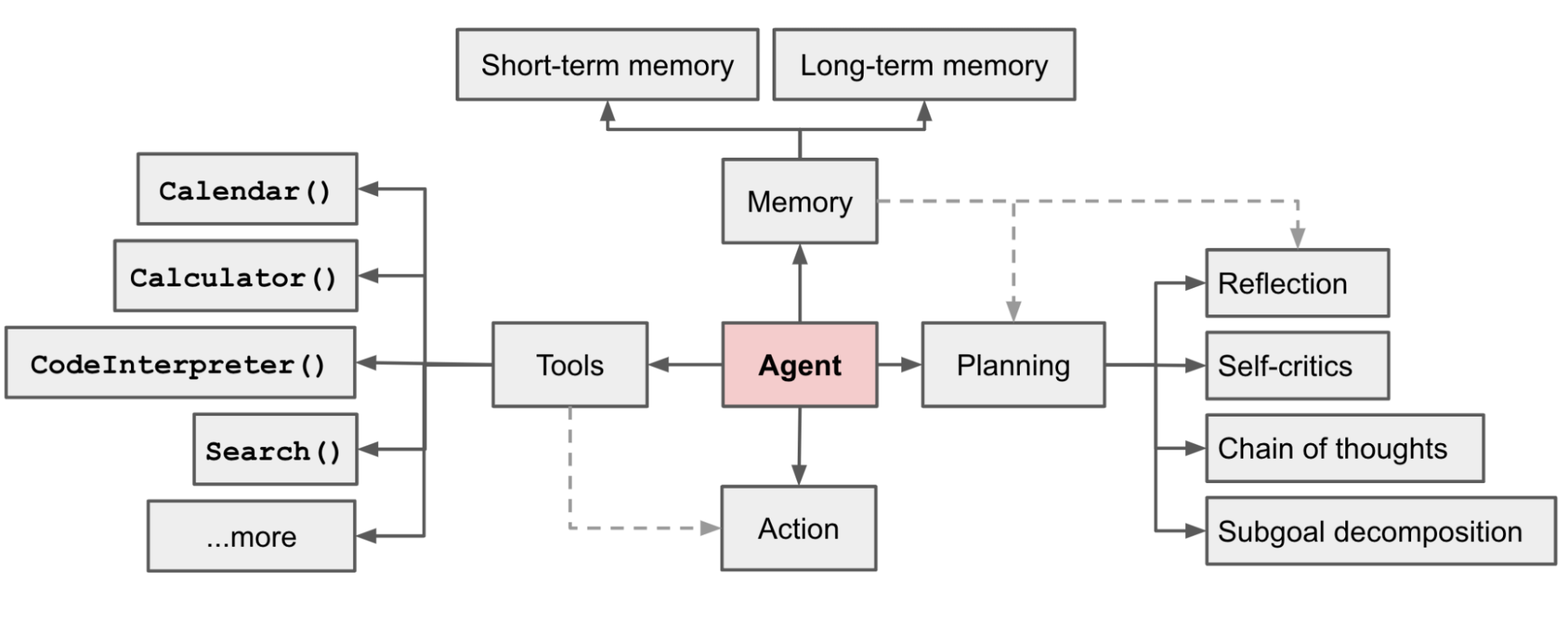 Source: Lilian Weng, "LLM Powered Autonomous Agents" (2023) — As autonomy increases from copilot to fully autonomous, agents require more sophisticated planning, memory, and tool-use capabilities.
Level 1: Copilot (Human Drives, AI Assists)
At the copilot level, the human is firmly in control of the workflow. The AI provides suggestions, completions, and information on demand, but the human makes every decision and performs every action.
Characteristics:
- AI responds only when prompted or triggered by human action.
- No tool calls or side effects — output is purely informational or suggestive.
- The human reviews, edits, and applies every suggestion manually.
- No agent loop; this is single-shot or streaming generation.
Examples:
- GitHub Copilot (inline completion): Suggests code as you type. You accept, reject, or modify each suggestion keystroke by keystroke.
- ChatGPT in conversation mode: Answers questions and provides code snippets that the user manually copies and applies.
- Grammarly: Suggests grammar and style corrections that the user individually accepts or ignores.
Risk profile: Minimal. The human is the bottleneck and the safety net. The worst outcome is a bad suggestion that the human ignores.
Level 2: Assistant (AI Proposes, Human Approves)
At the assistant level, the AI takes initiative by proposing multi-step plans or specific actions, but the human must explicitly approve before any action is executed. The AI reasons about what to do; the human decides whether to let it.
Characteristics:
- AI generates proposed actions (tool calls, edits, commands) and presents them for review.
- Human approval gates every action or batch of actions.
- The agent loop runs but pauses at each action for confirmation.
- Human can modify proposed actions before approving.
Examples:
- Claude Code (with permission prompts): Proposes file edits and terminal commands, displaying them for user approval before execution.
- Cursor (apply mode): Shows proposed code changes in a diff view; the user accepts or rejects each change.
- Copilot Workspace: Generates a plan and proposed code changes for a GitHub issue, but the user reviews and commits.
Risk profile: Low. The human reviews every action. Latency increases because of approval steps, but safety is maintained. Best for tasks where errors are costly (production deployments, database modifications).
Level 3: Semi-Autonomous (AI Acts, Human Monitors)
At the semi-autonomous level, the AI executes actions independently within defined boundaries, and the human monitors progress and intervenes only when needed. The agent has been granted trust to act, but guardrails and oversight mechanisms are in place.
Characteristics:
- AI executes tool calls without per-action approval.
- Human receives progress updates (streaming output, notifications, logs).
- Guardrails prevent certain high-risk actions (e.g.,
git push --force, deleting production data). - Human can interrupt at any time to redirect or halt.
- Pre-approved action categories with blocked action categories.
Examples:
- Claude Code (with allowed tools configured): Runs autonomously with pre-approved file operations and command execution, but blocks destructive git commands without explicit permission.
- Devin (Cognition): Works through software engineering tasks autonomously, posting progress to a Slack-like interface where the user monitors.
- Sweep AI: Autonomously creates pull requests from GitHub issues, with human review at the PR stage.
Risk profile: Moderate. The agent can make mistakes that must be caught through monitoring, code review, or automated testing. Best for tasks where errors are recoverable (code in a branch, sandboxed environments).
Level 4: Fully Autonomous (AI Acts Independently)
At the fully autonomous level, the AI receives a goal and executes it end-to-end without human involvement. It handles errors, makes judgment calls, and delivers results. Human involvement occurs only at the input (specifying the goal) and output (receiving the result).
Characteristics:
- No human in the loop during execution.
- Agent handles all error recovery and decision-making.
- Results are delivered as completed artifacts (merged PRs, deployed services, finished reports).
- Requires highest level of trust, testing, and safety infrastructure.
Examples:
- Automated CI/CD agents: Receive a failing test alert, diagnose the issue, write a fix, run tests, and create a PR — all without human intervention.
- Scheduled data pipeline agents: Monitor data quality, detect anomalies, apply corrections, and generate reports on a recurring schedule.
- Factory-deployed coding agents: Process a queue of well-scoped tickets autonomously, with human review only at the PR merge stage.
Risk profile: Highest. Errors may not be caught until the result is delivered. Requires sandboxing, comprehensive testing, rollback mechanisms, and audit logging. Justified only for well-defined, low-risk, reversible tasks.
Why It Matters
Matching Autonomy to Risk
The appropriate autonomy level depends on what is at stake. Editing a draft document warrants higher autonomy than modifying a production database. A mismatch — too much autonomy for a high-stakes task, or too little for a routine one — leads to either dangerous errors or frustrating inefficiency.
Progressive Trust Building
In practice, users and organizations move rightward along the spectrum as they build confidence. A team might start using a coding agent in copilot mode, graduate to assistant mode after a week, and eventually enable semi-autonomous mode for routine tasks. This progressive trust-building mirrors how organizations adopt any new technology.
Architecture Implications
Each autonomy level requires different technical infrastructure. Copilots need good suggestion generation. Assistants need action preview and approval UIs. Semi-autonomous agents need guardrails, monitoring dashboards, and interrupt mechanisms. Fully autonomous agents need sandboxing, comprehensive testing harnesses, rollback capabilities, and audit trails.
Key Technical Details
- Approval latency cost: Each human approval step adds 10-60 seconds of wall-clock time. A 30-step task with per-step approval takes 5-30 minutes of human attention; the same task in semi-autonomous mode takes only the initial instruction plus occasional monitoring.
- Guardrail implementation: Semi-autonomous agents typically use allowlists (permitted tools/commands) and blocklists (forbidden operations). Claude Code, for example, allows configuring
allowanddenyrules for specific tools and command patterns. - Error recovery rates by level: Copilots have near-zero autonomous error recovery (human handles all errors). Semi-autonomous agents recover from ~70% of errors autonomously. Fully autonomous agents must recover from ~90%+ to be viable.
- Cost per task vs. autonomy: Higher autonomy generally means higher API costs (more LLM calls for error recovery, exploration, and self-verification) but lower human time costs. The crossover point depends on the hourly cost of human attention vs. API pricing.
- Sandboxing for autonomous agents: Docker containers, virtual machines, or restricted filesystem access are standard for fully autonomous agents. The agent operates in an environment where its worst-case mistakes are contained and reversible.
- Monitoring overhead: Semi-autonomous agents require logging of all tool calls and outputs. Typical implementations log 500-5,000 lines per task for post-hoc review.
Common Misconceptions
"Fully autonomous is always the goal." Higher autonomy is not inherently better. For many use cases, assistant-level autonomy (AI proposes, human approves) is the ideal balance. Full autonomy introduces complexity, risk, and cost that may not be justified. The goal is the right level of autonomy for the task and context.
"Autonomy level is fixed for a given agent system." Most well-designed agents support configurable autonomy. Claude Code, for instance, can operate in interactive mode (assistant level) or headless mode (semi-autonomous to fully autonomous). The same agent can operate at different levels depending on configuration and context.
"Semi-autonomous means the agent asks for permission sometimes." Semi-autonomous means the agent acts without asking for most actions but has hard boundaries it cannot cross. The human monitors rather than approves. If the agent frequently asks for permission, it is operating at the assistant level, not the semi-autonomous level.
"Autonomous agents don't need safety measures because the LLM is smart enough." LLMs make mistakes on roughly 5-15% of complex decisions. At full autonomy with 50+ actions per task, this means multiple errors per task are statistically expected. Safety measures (sandboxing, guardrails, validation) are not optional — they are essential.
Connections to Other Concepts
- What Is an AI Agent? — The autonomy spectrum defines the degree to which the core agent capabilities (perception, reasoning, action) operate independently.
- The Agent Loop — The loop structure changes at each autonomy level: copilots have no loop, assistants pause the loop for approval, autonomous agents run the loop freely.
- Goal Specification — Higher autonomy requires more precise goal specification because there are fewer opportunities for mid-task clarification.
- Action Space Design — The action space must be designed with the autonomy level in mind: higher autonomy demands more restrictive action boundaries or stronger safety guardrails.
- Agent vs. Workflow — Fully autonomous agents converge toward workflows for well-defined tasks; the autonomy spectrum helps decide when to use which.
Further Reading
- Anthropic, "Building Effective Agents" (2024) — Discusses the spectrum from simple prompt chains to fully autonomous agents and when each is appropriate.
- SAE International, "J3016: Levels of Driving Automation" (2021) — The automotive autonomy levels (L0-L5) that inspired the widely-used framework for thinking about AI autonomy levels.
- Chan et al., "The Harms of AI Assistants: A Framework for Understanding Autonomy Risks" (2023) — Analyzes how increasing autonomy introduces specific categories of risk and proposes mitigation strategies.
- Google DeepMind, "Levels of AGI: Operationalizing Progress on the Path to AGI" (2023) — Proposes a framework combining capability and autonomy dimensions for classifying AI systems.