What Is Meta-Prompting?
Imagine you need to write a cover letter for a job application, but you are not a strong writer. Instead of struggling with the letter directly, you hire a writing coach. The coach does not write the letter for you -- they help you figure out what to say, how to structure it, and what tone to strike. Then you write the letter using their guidance. Meta-prompting works the same way: one LLM call generates a prompt (the coaching step), and a second LLM call uses that prompt to accomplish the actual task (the execution step). The first call is a prompt about prompts -- hence "meta."
Meta-prompting addresses a fundamental tension in prompt engineering: crafting effective prompts requires expertise, but the people who need LLM assistance often lack that expertise. By delegating prompt construction to the model itself, meta-prompting makes sophisticated prompt engineering accessible to non-experts. It also enables automated prompt optimization at scale -- instead of a human iterating on prompts manually, the system can generate, test, and refine prompts programmatically.
The concept has evolved from a curiosity into a practical production pattern. Prompt optimization platforms, automated testing systems, and "prompt engineer agent" architectures all use meta-prompting as a core mechanism.
When the task varies significantly across inputs (each customer query needs a slightly different approach) or when the prompt space is large (many possible phrasings and structures to explore), meta-prompting provides a systematic way to navigate that space.
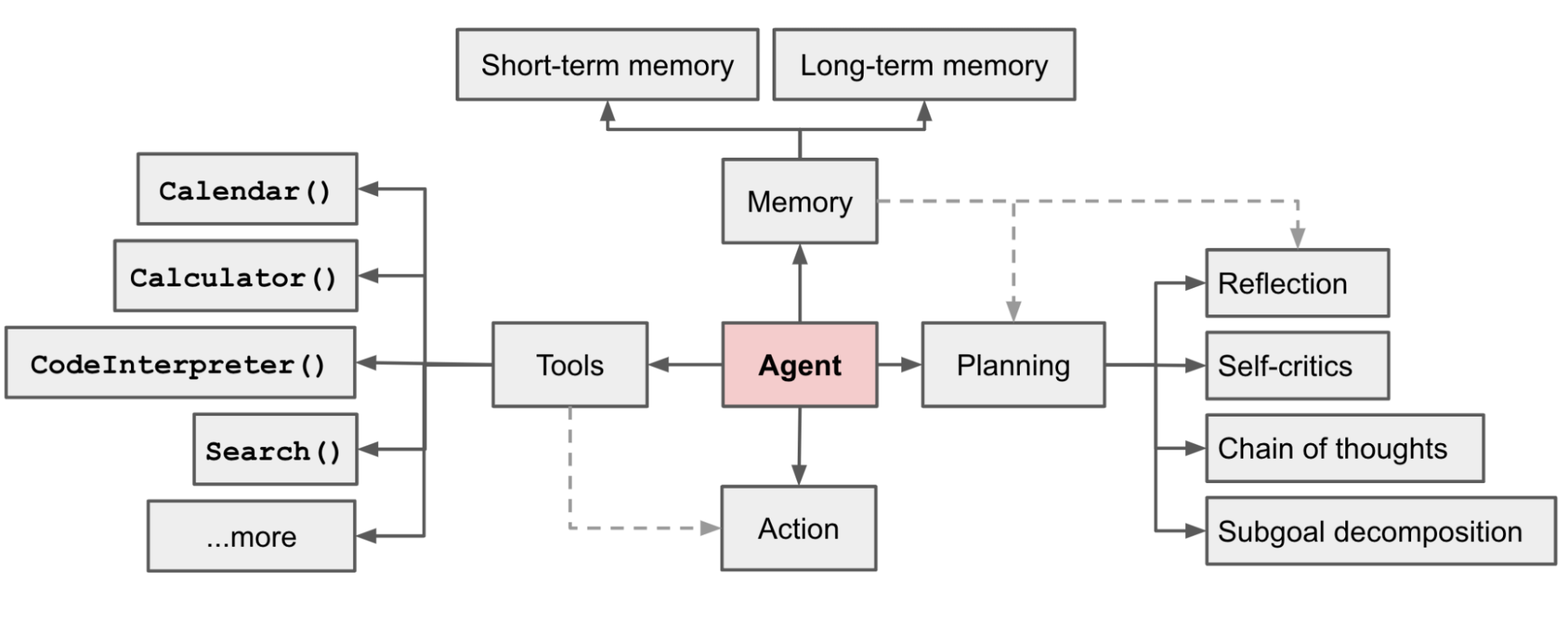 Source: Lilian Weng, "LLM Powered Autonomous Agents," lilianweng.github.io (2023) -- illustrates the multi-layer architecture concept where one component plans and another executes, analogous to meta-prompting's two-layer pattern
Source: Adapted from Yang et al., "Large Language Models as Optimizers (OPRO)" (2023) and Zhou et al., "Large Language Models Are Human-Level Prompt Engineers (APE)" (2023)
How It Works
The Two-Layer Architecture
Meta-prompting involves at least two LLM calls in sequence. The first call (the meta-layer) receives a high-level description of the task and generates a specific, optimized prompt for that task. The second call (the execution layer) receives the generated prompt along with the actual input and produces the final output.
The meta-layer might use a different model, different temperature, or different system prompt than the execution layer. For example, the meta-layer might use a strong reasoning model (Claude Opus, GPT-4) to generate prompts, while the execution layer uses a faster, cheaper model (Claude Haiku, GPT-4o-mini) to run them at scale.
This asymmetry is a key cost optimization: the expensive meta-layer runs once (or occasionally), while the cheap execution layer handles all user-facing traffic.
Prompt Optimization Through Iteration
The simplest form of meta-prompting generates a single prompt. More sophisticated approaches iterate: generate a prompt, test it on a set of examples, evaluate the results, and generate an improved prompt based on the evaluation.
This loop -- generate, test, evaluate, refine -- mirrors the human prompt engineering process but can run much faster and explore more variations. A single optimization cycle might take a human hours; an automated meta-prompting loop can complete 10 iterations in minutes.
Systems like DSPy and OPRO (Yang et al., 2023) formalize this loop, using the LLM as both the prompt generator and the evaluator, with automatic optimization toward a target metric.
Task-Specific Prompt Generation
Instead of maintaining a library of pre-written prompts for different task types, meta-prompting can generate task-specific prompts on the fly. Given a task description ("Extract the invoice number, date, and total amount from this document"), the meta-layer generates an optimized prompt with appropriate output format, examples, and constraints.
This is particularly valuable when the task space is large and heterogeneous -- a document processing system might encounter hundreds of document types, each requiring slightly different extraction logic. Generating per-task prompts dynamically is more scalable than manually crafting and maintaining hundreds of static prompts.
The Prompt Engineer Agent Pattern
The most advanced form of meta-prompting is an autonomous agent that maintains a prompt library, monitors execution performance, identifies failing cases, diagnoses root causes, and generates prompt improvements.
This agent pattern treats prompt engineering as a continuous optimization process rather than a one-time design task. The agent might observe that a customer service prompt has declining satisfaction scores on billing questions, analyze the failing conversations, hypothesize that the prompt lacks billing-specific instructions, generate and test an improved version, and deploy it if it outperforms the current version.
The prompt engineer agent pattern is still emerging and requires careful guardrails -- an autonomous system that modifies production prompts without human oversight can introduce subtle errors or remove safety constraints. Human-in-the-loop review remains essential for safety-critical applications.
Why It Matters
Scaling Prompt Engineering
Manual prompt engineering does not scale. A single prompt engineer can maintain perhaps 20-50 prompts with regular optimization. Meta-prompting enables automated maintenance of hundreds or thousands of prompts, each continuously optimized based on performance data. This is essential for large organizations with many LLM-powered features.
Accessibility
Meta-prompting democratizes prompt engineering by allowing non-experts to describe what they want in natural language and receive an optimized prompt. A product manager who writes "I need a prompt that extracts action items from meeting transcripts" can receive a well-structured prompt with appropriate formatting, examples, and edge case handling -- without needing to understand prompt engineering principles.
Continuous Improvement
LLM behavior changes with model updates, user population shifts, and evolving requirements. Meta-prompting enables continuous adaptation: as new failure modes are detected, the meta-layer generates improved prompts to address them. This creates a self-improving system that maintains performance over time without constant human intervention.
Cross-Model Prompt Translation
When migrating between model providers (e.g., from GPT-4 to Claude or vice versa), meta-prompting can generate model-specific prompt versions. A meta-layer can take a prompt optimized for one model and generate a variant tuned for another, accounting for differences in instruction-following behavior, formatting preferences, and capability profiles.
Key Technical Details
- Cost overhead: Meta-prompting adds the cost of the meta-layer call(s). For a single meta-prompt generation, this is 1x additional cost. For iterative optimization with 5-10 rounds, the total cost during optimization can be 10-50x a single call, though the optimized prompt is then reused across many executions.
- Optimization convergence: Iterative prompt optimization typically converges within 5-15 rounds on well-defined tasks, with the majority of improvement in the first 3-5 rounds.
- Model asymmetry: Using a stronger model for the meta-layer and a cheaper model for execution is cost-effective. The meta-layer runs once (or occasionally), while the execution layer runs on every user request.
- Evaluation requirement: Meta-prompting optimization requires an evaluation function (automated metrics or LLM-as-judge) to measure prompt quality. Without evaluation, the system cannot determine if generated prompts are better or worse.
- Prompt diversity: Meta-prompting at high temperature (0.7-1.0) generates more diverse prompt candidates; at low temperature (0-0.3), it generates more conservative refinements. The optimal strategy depends on whether exploration or exploitation is needed.
- Generated prompt quality: LLM-generated prompts are not always better than human-crafted ones. Meta-prompting works best when combined with human review, especially for safety-critical applications where a generated prompt might inadvertently remove important constraints.
- OPRO results: Yang et al. (2023) showed that LLM-optimized prompts achieved 8-50% improvement over human-written prompts on Big-Bench Hard tasks, demonstrating the potential of automated prompt optimization.
Common Misconceptions
-
"Meta-prompting means the model writes a perfect prompt on the first try." The initial generated prompt is rarely optimal. Meta-prompting's value comes from iterative refinement, where each round improves upon the last based on evaluation feedback. Single-shot meta-prompting is a useful starting point, not a finished product.
-
"Meta-prompting eliminates the need for prompt engineering expertise." It reduces the need for manual prompt crafting but introduces new challenges: designing the meta-prompt itself, building evaluation functions, setting up optimization infrastructure, and reviewing generated prompts for safety. The expertise shifts rather than disappears.
-
"Any model can do meta-prompting." The meta-layer requires strong instruction following, reasoning about task requirements, and knowledge of effective prompt patterns. Weaker models generate lower-quality prompts. Using a frontier model for the meta-layer is strongly recommended.
-
"Meta-prompting is too expensive for production." The meta-layer runs during development or optimization, not on every user request. A prompt optimized through 10 meta-prompting rounds is then used as a static prompt for thousands or millions of executions. The amortized cost is negligible.
-
"LLM-generated prompts are always safe." Generated prompts can inadvertently remove safety constraints, introduce biases, or create unexpected interactions. Human review of generated prompts is essential, especially for safety-critical applications.
Connections to Other Concepts
- System Prompt Anatomy -- Meta-prompting can generate each component of a system prompt (role, constraints, format) either independently or as a complete system prompt.
- Prompt Versioning and Management -- Meta-prompting generates new prompt versions that must be tracked, tested, and managed within a prompt versioning system.
- Dynamic System Prompts -- Meta-prompting can be integrated with dynamic prompts: the meta-layer generates task-specific blocks that are assembled into dynamic templates.
- Chain-of-Thought Prompting -- The meta-layer often uses CoT to reason about task requirements, identify potential failure modes, and justify prompt design decisions.
- Instruction Following and Compliance -- Understanding what makes instructions effective is essential knowledge for the meta-layer to generate high-compliance prompts.
Further Reading
- Yang, C., Wang, X., Lu, Y., et al. (2023). "Large Language Models as Optimizers." NeurIPS 2023. Introduces OPRO (Optimization by PROmpting), demonstrating that LLMs can optimize prompts through iterative refinement with up to 50% improvement on benchmarks.
- Khattab, O., Santhanam, K., Li, X. D., et al. (2023). "DSPy: Compiling Declarative Language Model Calls into Self-Improving Pipelines." Provides a framework for programmatic prompt optimization that implements meta-prompting at scale.
- Zhou, Y., Muresanu, A. I., Han, Z., et al. (2023). "Large Language Models Are Human-Level Prompt Engineers." ICLR 2023. Introduces APE (Automatic Prompt Engineer), demonstrating that LLMs can generate and select prompts that match or exceed human-designed prompts.
- Fernando, C., Banarse, D., Michalewski, H., et al. (2023). "Promptbreeder: Self-Referential Self-Improvement Via Prompt Evolution." Explores evolutionary approaches to meta-prompting, where prompts and meta-prompts co-evolve.