
Season one · stop 4 · Temperature and sampling

How It Picks the Next Word

“A model doesn't know what comes next. It has odds for every possibility. You'll turn the temperature dial yourself and see the odds reshape, from safe and repetitive to wild.”

Unpacking the world: 1.7 MB of drawings and measured data.

AgenticAmit A field guide to temperature

Field guide · temperature

How it picks the next word.

A model doesn't know what comes next. It has odds for every possibility, and one dial decides how boldly it bets. We opened up GPT-2 and turned the dial ourselves.

Scroll to follow the river ↓

The sentenceGPT-2 small · 124M parameters
What comes next?
Step 1 · raw scores (logits)top 12
Every piece gets a score.

The dialtemperature
1.0
chance ∝ escore ÷ T
Pinned · the dial, definedarXiv 2015

Hinton, Vinyals and Dean: Neural networks typically produce class probabilities by using a softmax output layer that converts the logit, z_i, computed for each class into a probability, q_i, by comparing z_i with the other logits: q_i = exp(z_i/T) / sum over j of exp(z_j/T). Hinton, Vinyals and Dean: where T is a temperature that is normally set to 1. Using a higher value for T produces a softer probability distribution over classes.

Hinton, Vinyals & Dean · Distilling the Knowledge in a Neural Network

Pinned · the loop, measuredICLR 2020
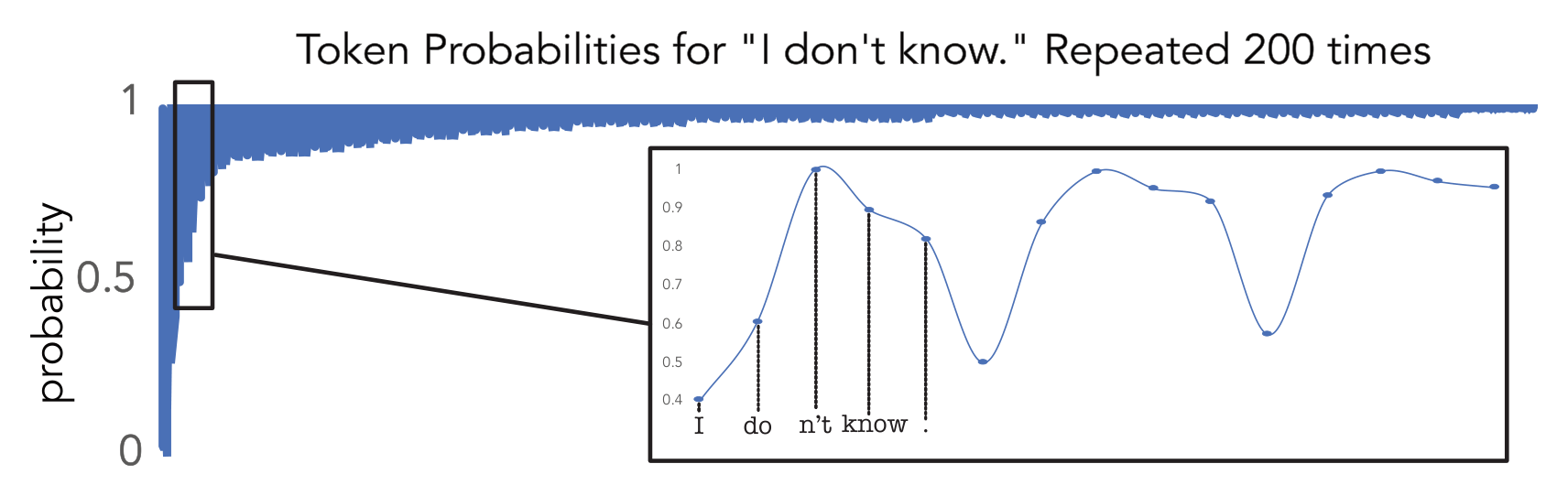
Holtzman et al. Figure 4: token probabilities for the phrase I don't know. repeated 200 times; the probability rises with each repetition. Holtzman et al.: The probability of a repeated phrase increases with each repetition, creating a positive feedback loop.

Holtzman, Buys, Du, Forbes & Choi · The Curious Case of Neural Text Degeneration

Pinned · top-pICLR 2020

Holtzman et al.: To address this we propose Nucleus Sampling, a simple but effective method to draw the best out of neural generation. By sampling text from the dynamic nucleus of the probability distribution, which allows for diversity while effectively truncating the less reliable tail of the distribution.

Holtzman et al. · Nucleus Sampling

Fig. 04 · five settings, 30 promptsGPT-2 small
Cold loops. Hot rambles.

Pinned · a dial you can setOpenAI API reference
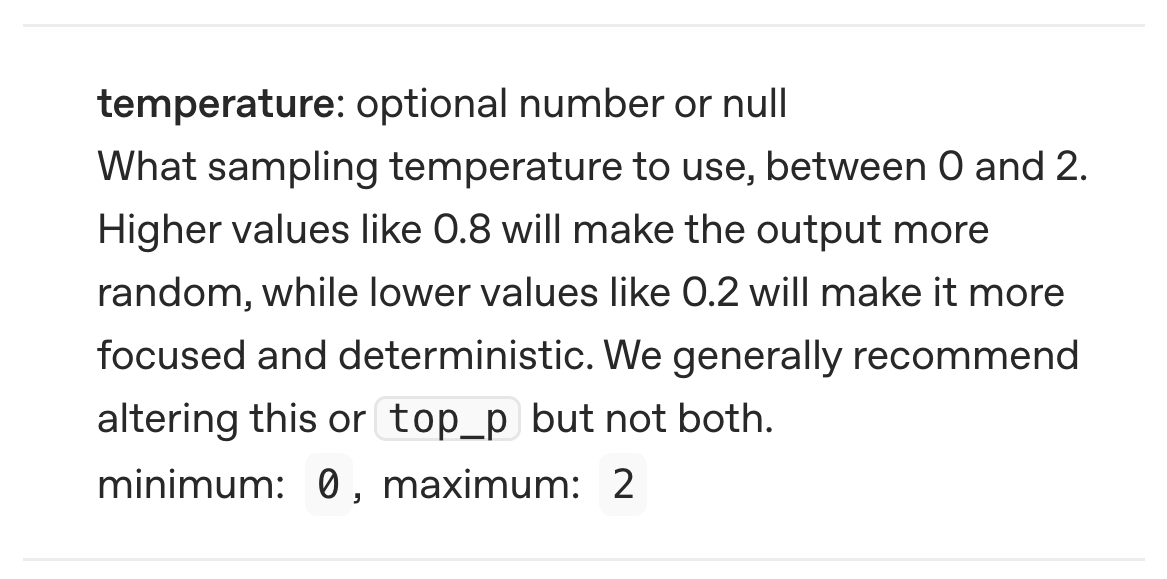
OpenAI API reference: What sampling temperature to use, between 0 and 2. Higher values like 0.8 will make the output more random, while lower values like 0.2 will make it more focused and deterministic. We generally recommend altering this or top_p but not both.

developers.openai.com · retrieved 28 Sep 2026

Pinned · a dial on its way outAnthropic API reference
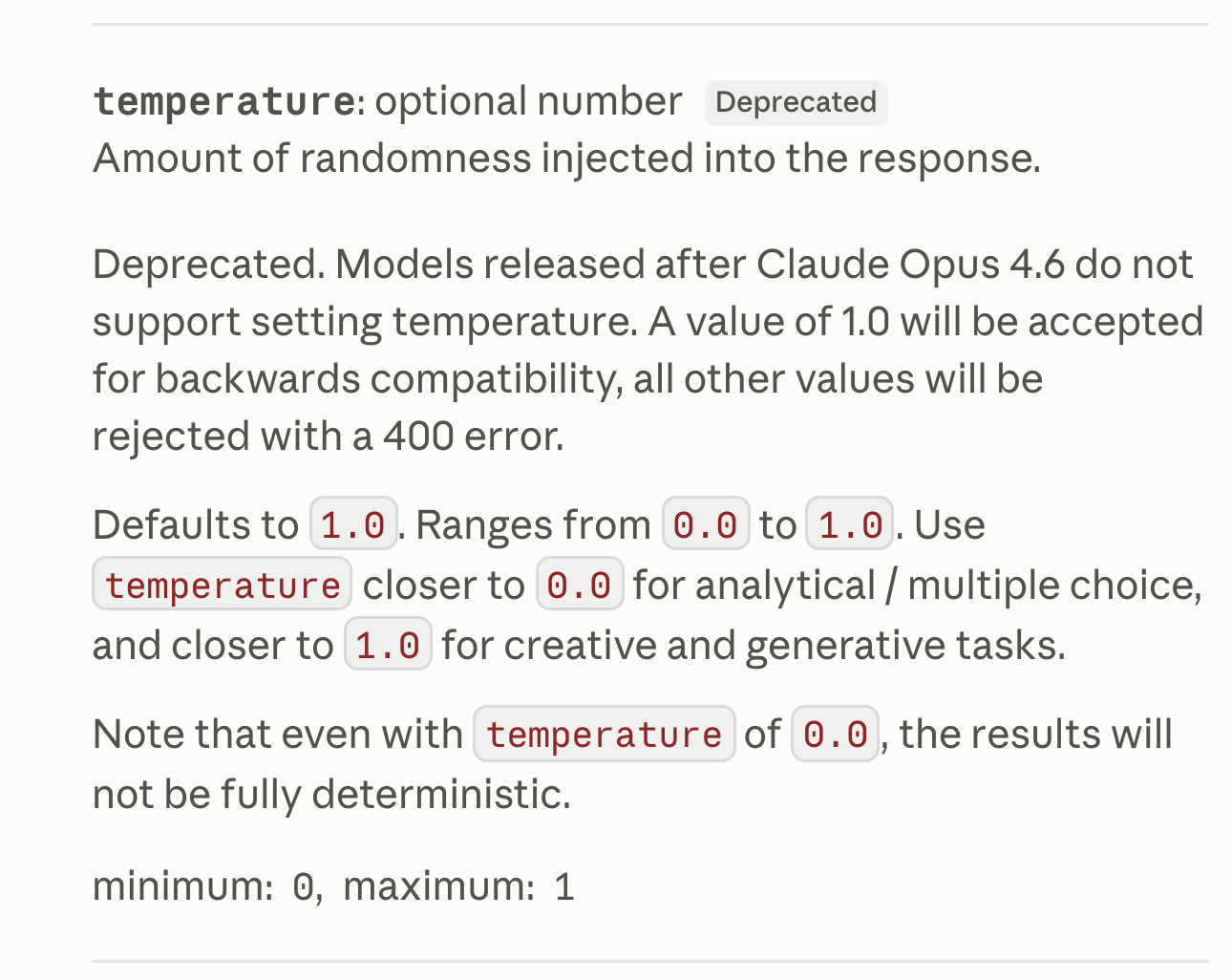
Anthropic API reference for temperature, marked deprecated: models released after Claude Opus 4.6 accept only temperature 1.0.

platform.claude.com · retrieved 28 Sep 2026

Take this with you

The model gives odds. The dial decides how boldly it bets.

Turn it down and it plays safe, sometimes so safe it repeats itself. Turn it up and it takes long shots, sometimes into nonsense. Nothing about what the model knows changes. Only how it chooses.

Amit, relieved

