What Is This Decision?
Imagine you need to get across town. You could walk, take a bus, hail a taxi, or charter a helicopter. Each option trades off cost, speed, flexibility, and reliability differently. Walking is cheap and predictable but slow. A taxi is flexible but expensive. A helicopter can go anywhere but costs orders of magnitude more and introduces new failure modes. Choosing a helicopter to go three blocks is not just wasteful --- it is worse than walking because of the overhead.
The same logic applies when building with LLMs. An autonomous agent (the helicopter) gives you maximum flexibility: it can reason, use tools, adapt to unexpected situations, and pursue open-ended goals. But that flexibility costs 6-10x more tokens than a coded workflow for the same task, introduces non-deterministic behavior, and is harder to debug. Most LLM-powered features do not need an agent. The first design decision you should make is whether you need one at all.
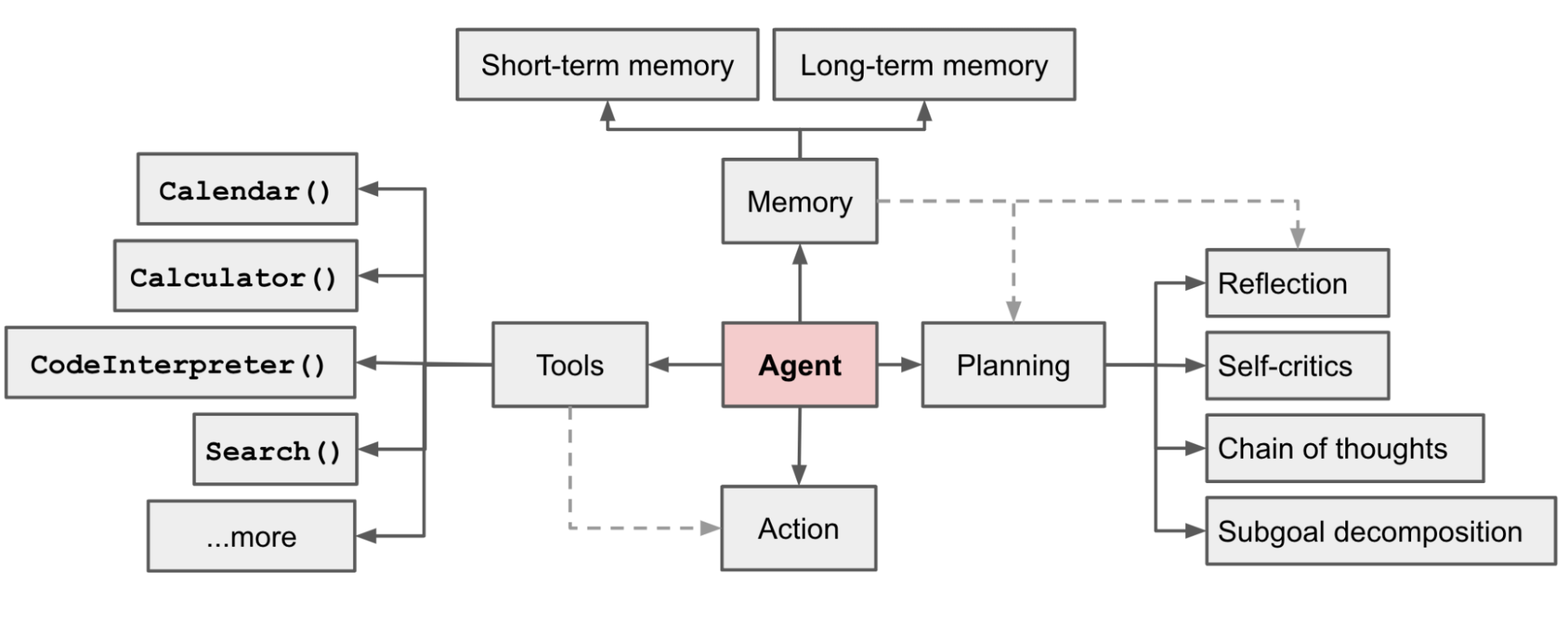 Figure: The full architecture of an LLM-powered agent (from Lilian Weng, 2023). Before building all of this, ask whether your task actually requires it -- most do not.
How It Works
The Five-Question Triage
Before reaching for an agent framework, answer these five questions about your task:
| # | Question | If "No" | If "Yes" |
|---|---|---|---|
| 1 | Does the task require multiple tool calls whose sequence cannot be predicted in advance? | Consider a prompt chain or coded workflow. | Continue to Q2. |
| 2 | Does the task require adaptive decision-making based on intermediate results? | A DAG workflow or routed pipeline likely suffices. | Continue to Q3. |
| 3 | Can the task tolerate non-deterministic outputs and occasional failures? | Use a coded workflow with retries. | Continue to Q4. |
| 4 | Is the task high-value enough to justify 6-10x token cost and added latency? | Use a simpler pattern. | Continue to Q5. |
| 5 | Do you have observability infrastructure to monitor and debug autonomous behavior? | Build that infrastructure first. | An agent is appropriate. |
If you answered "No" to any question, that row tells you the simpler alternative to use.
The Alternatives Spectrum
| Pattern | Token Cost (relative) | Latency | Determinism | Best For |
|---|---|---|---|---|
| Direct LLM call | 1x | Low | High | Classification, extraction, summarization |
| Prompt chain | 2-3x | Medium | High | Multi-step transforms with known sequence |
| RAG pipeline | 1.5-2x | Medium | High | Knowledge-grounded Q&A |
| Routed workflow | 2-4x | Medium | High | Tasks with branching logic based on input type |
| Coded workflow with tools | 3-5x | Medium | Medium-High | Structured multi-tool tasks with known steps |
| Single agent | 6-10x | High | Low | Open-ended tasks requiring adaptive tool use |
| Multi-agent system | 10-30x | Very High | Very Low | Complex tasks requiring specialized roles |
Problem Complexity Scoring
Score your problem on these four dimensions (1-5 each):
- Path unpredictability: How many different tool-call sequences could solve the task? (1 = one known path, 5 = completely open-ended)
- Intermediate reasoning: How much does step N+1 depend on interpreting the result of step N? (1 = not at all, 5 = completely)
- Error recovery need: How often will tool calls fail or return unexpected results that require re-planning? (1 = rarely, 5 = frequently)
- Domain breadth: How many distinct tool categories does the task span? (1 = one tool, 5 = five or more tool types)
Scoring guide:
- 4-8 total: Use a direct call, prompt chain, or coded workflow.
- 9-13 total: Use a routed workflow or coded workflow with tools.
- 14-20 total: An agent is justified.
Cost Reality Check
Concrete cost comparison for a "research a topic and write a summary" task:
- Prompt chain (retrieve, synthesize, format): ~4,000 tokens input + ~1,500 output = ~5,500 tokens total. Predictable, fast.
- Single agent (iterative search, evaluate, search more, synthesize): ~25,000-40,000 tokens across 5-8 loops. Better results on ambiguous queries, but 5-7x the cost.
If you run this task 10,000 times per day, the difference is $15/day vs $90/day at typical API pricing. Over a year, that is $5,400 vs $32,400. The agent must deliver meaningfully better outcomes to justify that gap.
Why It Matters
Over-Engineering Is the Default Failure Mode
The most common mistake in LLM application development is reaching for an agent when a prompt chain would work. Agent frameworks are exciting, well-marketed, and feel like the "advanced" choice. But complexity is a liability, not an asset. Every additional reasoning step is a chance for the model to hallucinate, choose the wrong tool, or get stuck in a loop. Simpler systems fail in simpler, more debuggable ways.
Agents Shine in Specific Niches
Agents genuinely excel when: the user's intent is ambiguous and requires clarification, the tool-call graph cannot be known in advance, intermediate results materially change the strategy, and the task is high-value enough to absorb cost and latency. Coding assistants, research agents, and complex customer service workflows are legitimate agent use cases. Reformatting a JSON payload is not.
The Reversibility Principle
Start with the simplest pattern that could work. You can always promote a prompt chain into an agent later by wrapping it in a reasoning loop. Going the other direction --- simplifying an agent into a workflow --- is much harder because you have to reverse-engineer the implicit decision logic the agent was performing.
Key Technical Details
- Agents use 6-10x more tokens than coded workflows performing the same task, based on benchmarks from Anthropic and LangChain evaluations.
- Each agent loop iteration adds 1-3 seconds of latency per LLM call, making 5-loop agents take 5-15 seconds minimum.
- Agent success rates on tool-use benchmarks (e.g., BFCL, ToolBench) range from 65-85%, meaning 15-35% of runs produce errors or suboptimal results.
- Prompt chains with hardcoded tool sequences achieve 95%+ reliability for structured tasks.
- The median production agent (per LangSmith traces) makes 3-7 tool calls per task. If your task needs exactly 2 calls in a known order, you do not need an agent.
- Multi-agent systems multiply cost roughly linearly with agent count: 3 agents cost roughly 3x a single agent.
- Debugging an agent failure requires tracing the full reasoning trajectory. Without observability tooling, you are flying blind.
Common Misconceptions
"Agents are always better because they can handle edge cases." Agents handle edge cases by spending more tokens reasoning about them. If your edge cases are enumerable, explicit branching in a coded workflow handles them more cheaply and reliably. Agents are for edge cases you cannot enumerate in advance.
"I need an agent because my task uses tools." Tool use does not require an agent. A coded workflow can call tools in a fixed or branching sequence. An agent is only needed when the model must decide which tools to call and in what order, dynamically.
"Agents are too unreliable for production." Agents are unreliable for tasks that do not need agents. When applied to genuinely open-ended problems with proper guardrails, they achieve production-grade reliability. The issue is misapplication, not the pattern itself.
"Starting with an agent and simplifying later is fine." It is not. Agent codebases accumulate implicit decision logic that is hard to extract. Starting simple and promoting to an agent is dramatically easier than the reverse.
Connections to Other Concepts
- Complexity Gradient formalizes the principle of starting simple that this decision framework embodies.
- Architecture Selection Framework picks up where this file leaves off --- once you have decided you need an agent, it helps you choose which agent architecture.
- agent-vs-workflow provides the foundational distinction between agents and workflows that this framework applies.
- autonomy-spectrum maps the range of autonomy levels, helping you calibrate how much control to hand to the LLM.
- cost-optimization covers how to reduce costs once you have committed to a pattern.
Further Reading
- Anthropic, "Building Effective Agents," 2024 --- Argues strongly for preferring simpler patterns and provides concrete workflow examples.
- Yao et al., "ReAct: Synergizing Reasoning and Acting in Language Models," ICLR 2023 --- Establishes the agent loop pattern, useful for understanding what agents actually do.
- LangChain, "Agent Evaluation with LangSmith," 2024 --- Real production data on agent token usage, latency, and success rates.
- Weng, Lilian, "LLM Powered Autonomous Agents," 2023 --- Comprehensive survey that clarifies where agents add value vs. overhead.